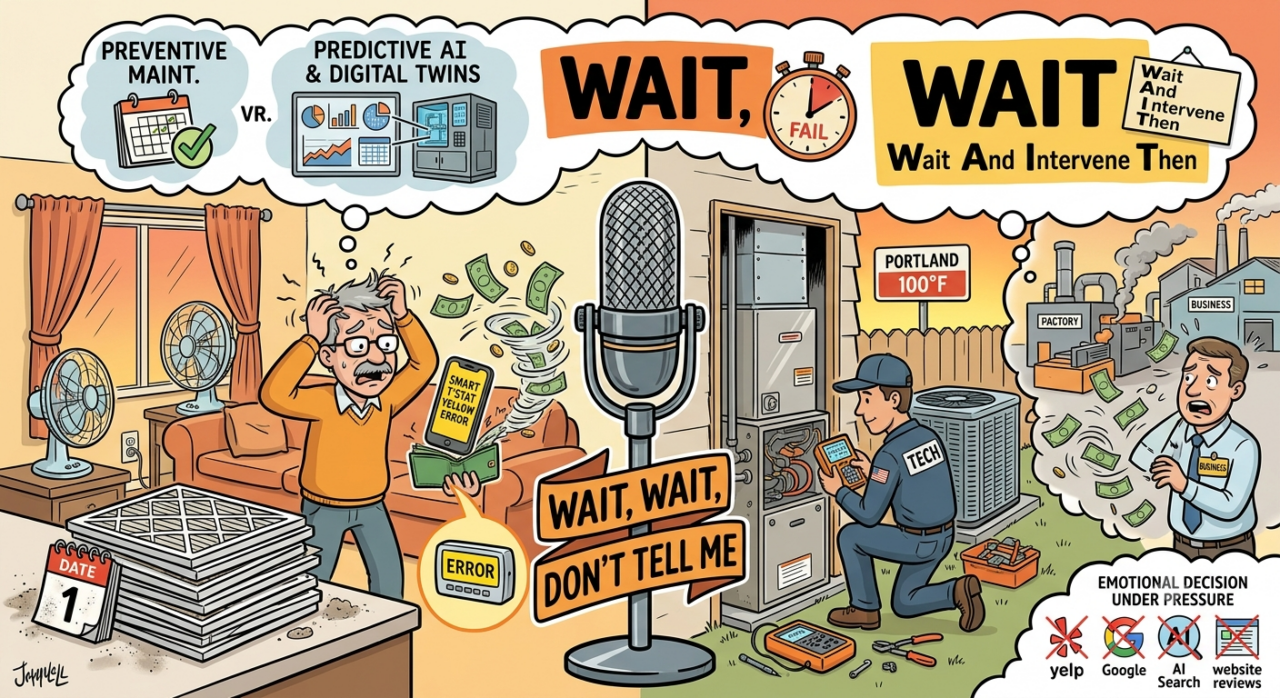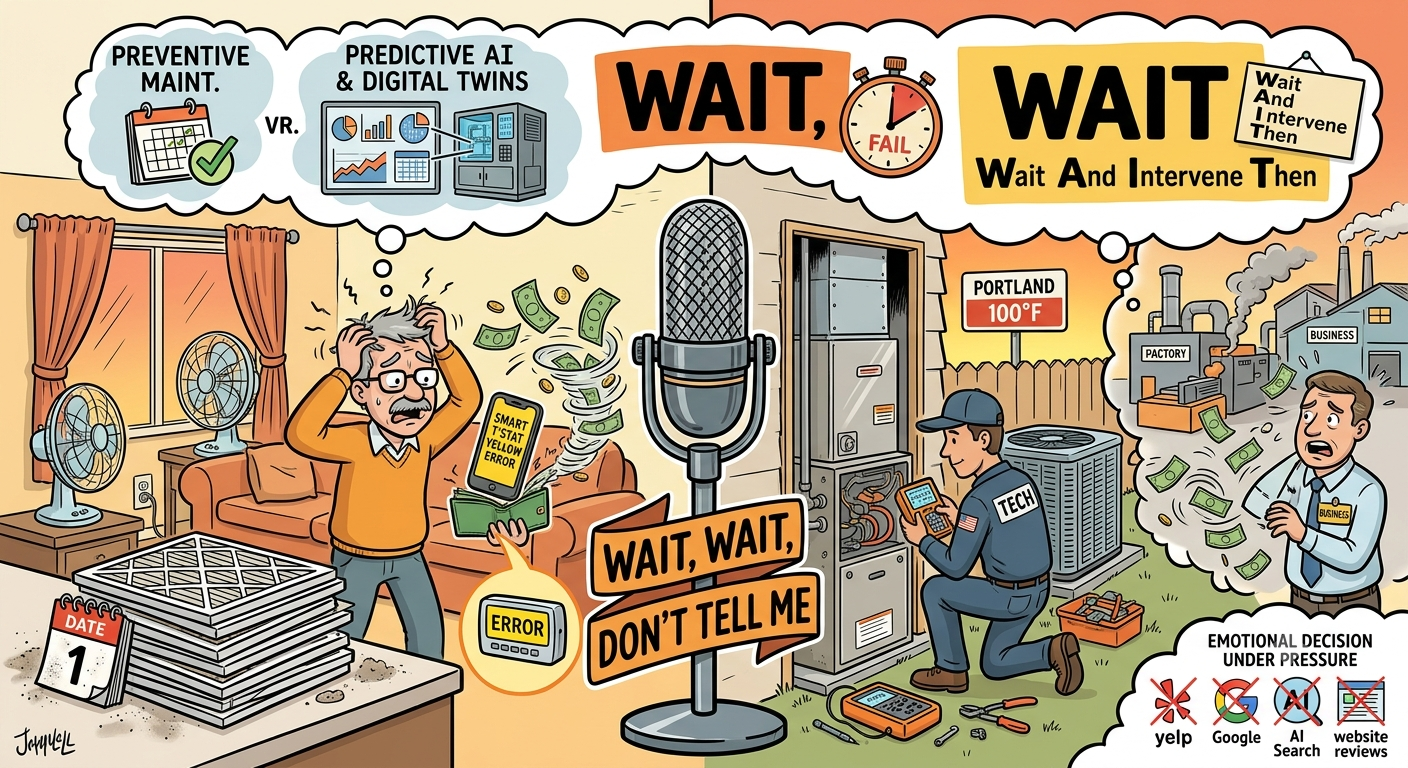
That’s the name of a fun radio show on National Public Radio. But, this Business Accelerants Memo or dispatch is based on a personal story from this last week.
The story begins in the spring of this year when temperatures reached over 90 and close to 100 several times when it should have been cold and rainy in Portland. A week ago, some areas around Portland were over 100 degrees. (I bet you have some idea where this is going.) On Thursday, I noticed the air coming out of the vents was no longer cool and the house was heating up—in spite of the smart thermostat set where it should be cool.
My first thought was to check ground fault interrupters. Nope—no issues there. Next was to try a reboot. I turned power off, let things cool, and then restarted. Then I WAITed to see if it would start working again. Nope—no such luck.
For the rest of the evening on Thursday it was keep everything closed up to avoid letting heat in. Keep the furnace fan moving air and turn on some more electric fans. Then, when it barely got cool enough, open the windows and keep the fans going.
Friday morning was calling around to find someone that could come and check things out. Maybe even repair it?
How do you even select someone when you are under the gun like this? Yelp reviews? Google search? AI search? Check out their websites? Yep, tried all of that. Had a list of 6 and the best I had in Friday afternoon was an appointment for Monday afternoon with a company whose trucks I’ve seen around and, I think I recall, did some late night television commercials on some cable channel. They said they would reconfirm on Saturday. Monday afternoon was better than the others that said they were scheduling out 2 weeks and would put me on a waiting list. Was the one scheduled for Monday less good because it was readily available and all the others were better and busy?
Checked on one set of potentials by using the suggested “authorized” or “accredited” according to the manufacturers website. Got a cll back from them Friday afternoon and they could come by Saturday morning. Eureka! Except all they advertise is to come to do diagnostics. Repair is another thing.
The company provided text confirmations immediately and helped me feel more comfortable. Saturday morning came and the HVAC tech was polite. I was offered 3 alternatives from least expensive and under $500, to medium cost, to high cost of well over $1K. I asked about parts availability expecting it to be only the cheap option being on the truck. To my surprise all the parts were available on the truck and the tech had time to fix it right now, even though he had four more appointments that day. I said go ahead and do the expensive option.
I verified that everything was working after he left. Then I noticed it. That smart thermostat now had some yellow text indicating an equipment problem. I spent time and effort trying to find the instructions for that device. I followed the on-screen instructions and went to the website to see the definition of the problem. Nothing seemed to help. I checked the iPhone app to see what could be done there. I decided to try another “reboot.” And then I WAITed, again.
Lucky me, the error message cleared itself and the air is the comfortable temperature we want.
In the process of preparing for the tech, I noticed I had put aside a new furnace filter with the expectation I would change it yearly. It’s Monday and I checked and was disappointed to find it was last replaced 2.5 years ago. At least I had used a marker to indicate the date. Wow, it was dirty. I have learned over time that an air filter often works better when there is some dirt on it. But this was beyond that point. Time to queue up another replacement to have on hand.
I’m out some money. AND, I’m chagrined with a few things you may relate to in business.
- I should have done some maintenance and checking on both the A/C and the furnace over the 5 years since they were installed.
- I’m not as good at keeping manuals and warranties where I can find them as I thought.
- Good intentions for maintaining the filter and having one on hand is not as good as actually replacing the filter.
- I’m sorry I don’t do as I say since I preach maintenance on fixed intervals or predictive maintenance, or using digital twins, or artificial intelligence review of key predictive and performance indicators.
- I made several emotional decisions (very much unlike me) while under pressure to ensure my family was kept comfortable.
I spent time and effort today on warranty today. Used the iPhone to take pictures of model numbers and serial numbers and the internet to connect with the company. Most of the warranty expired in April, 5 years on from installation and registration. BUT, one item has a 10-year warranty. BUT, I have to have that filed by the installer. Oh yeah, he worked on the side since his regular company, that I knew well, is focused on commercial HVAC. And he was moving out of town soon after the installation. Maybe I could get a couple hundred dollars back, as I do have contact information for the installer. That is, if it is still accurate. I have to ask, how much is my time worth?
I know that many people in manufacturing have similar issues. We all take bets that something bad will not happen and we can continue on our way happily.
Why did I call this WAIT and highlight that word? I used GEMINI to help me with the title. Here are some of the options to my query. I liked WAIT just a bit better than the others that ranked high on my list. I’ve left out the RUF ones.
WAIT Wait and Intervene Then
RAM Repair After Malfunction
BAM Breakdown And Maintain
ROF Repair On Failure
FOF Fix On Failure
If you are interested, here is the query I used:
I’m looking for an acronym that is a pronounceable word representing waiting until something fails to repair or replace versus doing regularly scheduled maintenance or predictive maintenance or even using artificial intelligence projects or electronic twins to provide maintenance. My first thought is RAF for Repair As Fail, but that does not quite meeting my intent. What are some suggestions?
Opportunities
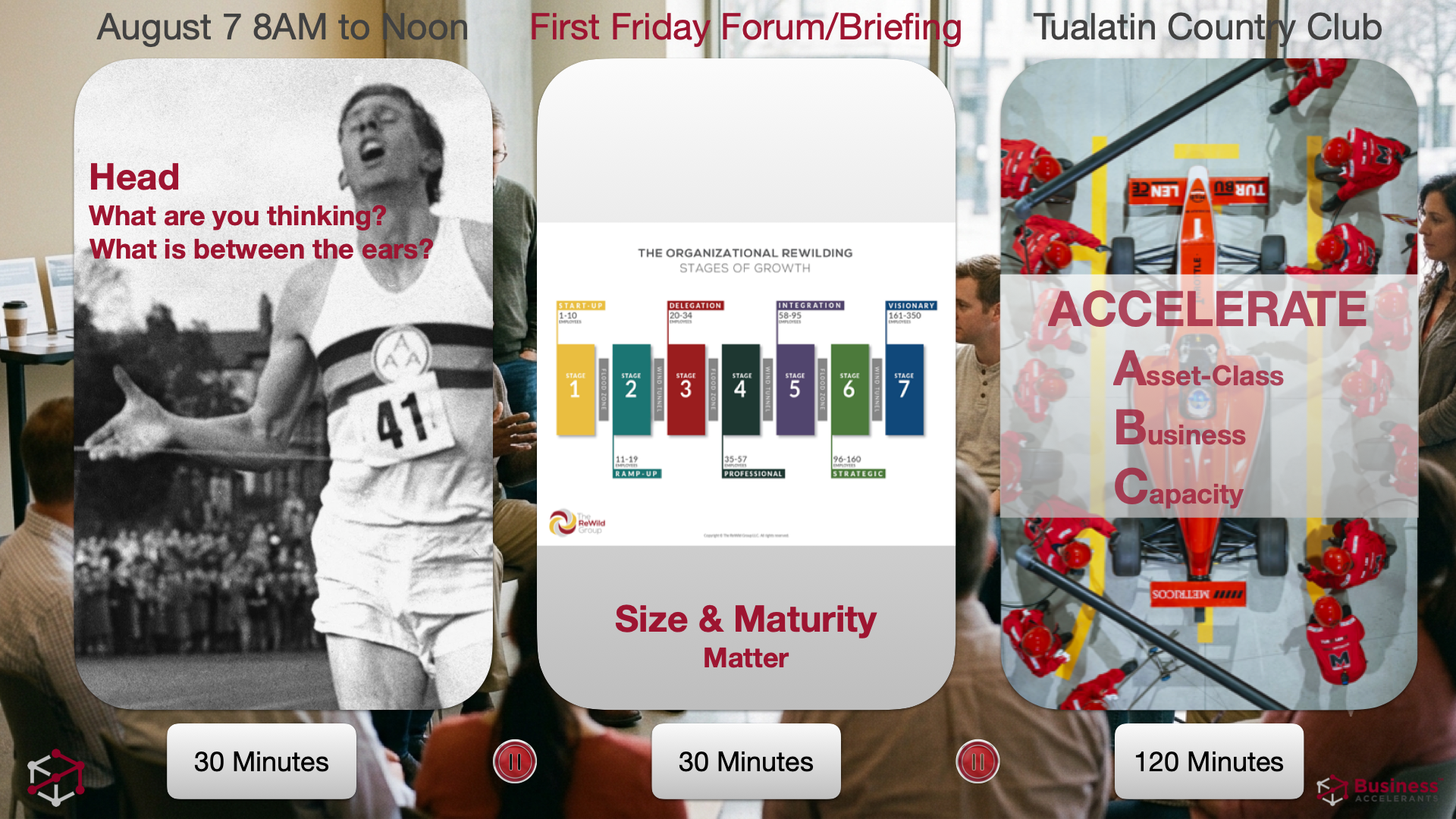
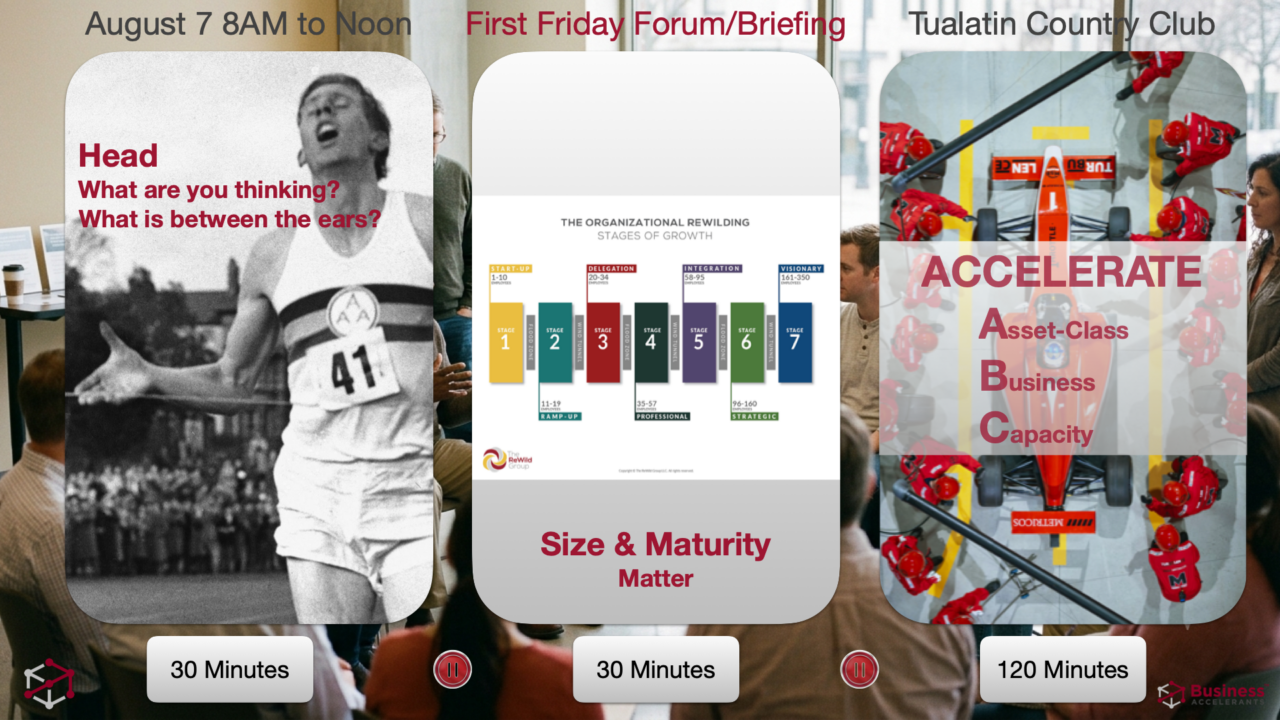
- Brand and Core Values Training using The ReWild Group materials
- August 7, 8AM to Noon at the Tualatin Country Club
- Navigate to a Business that Runs withOUT You
- Limited to 14 people. Register on EventBrite: https://www.eventbrite.com/e/navigate-to-a-business-that-runs-without-you-tickets-1993773048860?aff=oddtdtcreator&keep_tld=true
- August 11-27. Finance Bootcamp by Profit Mastery University
- Six sessions, 12 hours, live on Zoom, Aug 11 to 27. Miss one live and you get the recording. The seat is $495. Seats are limited and the cohort starts August 11.
- What we cover, session by session
- Aug 11: Read your financials. The P&L, balance sheet, and cash flow, in plain English.
- Aug 13: Margin and pricing. Find your real margin and the price that protects it.
- Aug 18: Break-even and the few KPIs that actually run your business.
- Aug 20: Build your 13-week cash forecast and see your cash weeks ahead.
- Aug 25: Turn your statements into a one-page scoreboard you check every week.
- Aug 27: Put it together into a plan you can run on Monday.
- REGISTER at: https://www.profitmastery.net/event-master-your-numbers-bootcamp?utm_source=the_profit_move&utm_medium=email&utm_campaign=pmu-bootcamp-virtual-august-2026&_bhlid=3d92788069821f354ad0313b75597fd70c07087b
Quotes
“Prepare and prevent, don’t repair and repent.”
— Author Unknown
“An ounce of prevention is worth a pound of cure.”
— Benjamin Franklin
“If you don’t have time to do it right, you must have time to do it over.”
— John Wooden
Books
1. Uptime: Strategies for Excellence in Maintenance Management (3rd Edition)
- Authors: John D. Campbell, James V. Reyes-Picknell, and Kim H. Nathan
- Why it fits: Widely considered the “bible” of maintenance strategy, Uptime walks through the exact operational maturity curve you referenced—moving away from reactive “run-to-failure” traps and establishing structured preventative and predictive asset management. It provides a pragmatic business context for why emergency repairs end up costing exponentially more than planned maintenance.
2. Digital Twin Technologies and Smart Cities
- Authors: Maryam Farsi, Alireza Daneshkhah, et al.
- Why it fits: If you want a deep dive into the technology side of predictive maintenance, this book explicitly bridges the gap between physical infrastructure (like HVAC, industrial equipment, and fleets) and digital twin simulation models. It explores how streaming sensor data and AI are used to detect early micro-anomalies long before a system triggers an outright failure or error code.
3. AI in Maintenance & Reliability: Predictive and Prescriptive Maintenance with Artificial Intelligence
- Author: Dr. Mohammed Hamed Ahmed Soliman
- Why it fits: This book focuses specifically on the current paradigm shift—moving from old-school scheduled maintenance routines to AI-driven, machine learning, and predictive models. Soliman bridges technical concepts with executive decision-making, showing how organizations can use AI to forecast failures accurately, calculate ROI, and avoid emotional, under-pressure decisions when critical assets break down.